
 EN
EN

In rail infrastructure and structural engineering, ensuring that a base plate works seamlessly with its fastening components is one of the most critical yet frequently underestimated steps in the assembly process. A mismatch between the base plate and the fasteners used to secure it can lead to instability, accelerated wear, and ultimately costly failures that interrupt operations or compromise safety. Whether you are working with wooden sleeper systems, concrete tracks, or steel substructures, the compatibility between the base plate and its fastening hardware must be validated before installation begins.
The challenge many procurement managers and track engineers face is that fastening systems vary considerably in design, material, and load specification. A base plate that fits perfectly within one fastening ecosystem may perform poorly in another. This article provides a structured approach to evaluating and confirming compatibility, covering dimensional standards, material properties, load distribution requirements, and quality verification procedures. By the end, you will have a clear framework for making confident decisions during specification, sourcing, and installation.
Understanding Base Plate Functions in Fastening Systems
The Role of the Base Plate in Load Transfer
The primary function of a base plate is to act as a distributing interface between a rail or structural member and the substrate beneath it. In rail applications, it spreads the dynamic and static loads generated by rolling stock across a wider surface area, reducing stress concentration on the sleeper or tie. This load distribution role is inseparable from how the fastening components engage with it.
When fasteners such as clips, bolts, spikes, or screws are applied to a base plate, they must do more than simply hold it in place. They must work together with the plate geometry to maintain rail gauge, provide the correct toe load, and resist longitudinal, lateral, and vertical forces. Any dimensional or material mismatch between the base plate and these components disrupts this cooperative load path and introduces unpredictable stress into the assembly.
Understanding this functional relationship is the first step toward ensuring compatibility. Engineers and procurement professionals should treat the base plate and its fasteners as a single integrated system, not as independent parts that happen to be assembled together. Design documentation for both elements should be reviewed simultaneously.
Common Fastening Components Paired with Base Plates
Fastening components associated with a base plate can include elastic rail clips, hook bolts, coach screws, spring washers, flat washers, ribbed baseplates with integral shoulders, and insulating pads. Each component plays a defined mechanical role, and each introduces specific dimensional and material requirements onto the base plate itself.
For instance, elastic clips require precisely machined or formed shoulders on the base plate to achieve the correct toe load. Hook bolts require specific hole geometries and edge clearances. Coach screws driven into wooden sleepers demand that the base plate's hole pattern exactly matches the prescribed sleeper spacing and screw diameter. Any deviation in these dimensions reduces joint integrity.
Procurement teams sourcing a base plate for replacement or new construction must therefore collect the full fastener specification sheet before finalizing their order. This sheet will typically include bolt circle diameter, hole tolerance ranges, clip seat dimensions, and surface finish requirements that must be matched by the base plate supplier.
Dimensional Compatibility Checks
Hole Pattern and Bolt Circle Alignment
The most fundamental dimensional check when verifying base plate compatibility is the hole pattern. Every fastener engagement point on the plate must align precisely with the mating component's geometry. For bolt-down systems, this means verifying bolt circle diameter, individual hole diameter, and hole position tolerances against the fastener supplier's specification.
Even a small misalignment in the hole pattern of a base plate can cause significant problems during installation. If holes are off-center by even a millimeter or two, bolts may thread at an angle, elastic clips may not seat correctly, or the plate may require forced fitting that introduces pre-stress into the assembly. Over time, forced-fit assemblies tend to loosen under vibration, leading to rail movement and potential gauge deviation.
To avoid this, always request a dimensioned drawing from your base plate supplier and compare it point by point against the fastener technical data sheet. Where possible, request physical samples from both suppliers and perform a dry-fit test before placing a full production order.
Thickness, Profile, and Edge Geometry
Beyond the hole pattern, the overall thickness and profile of the base plate must suit the fastening system. Thickness affects the grip length of bolts and the effective clamping range of elastic clips. If the plate is thinner than specified, clip toe loads will be too high; if it is too thick, clips may not achieve sufficient toe load to maintain the rail position.
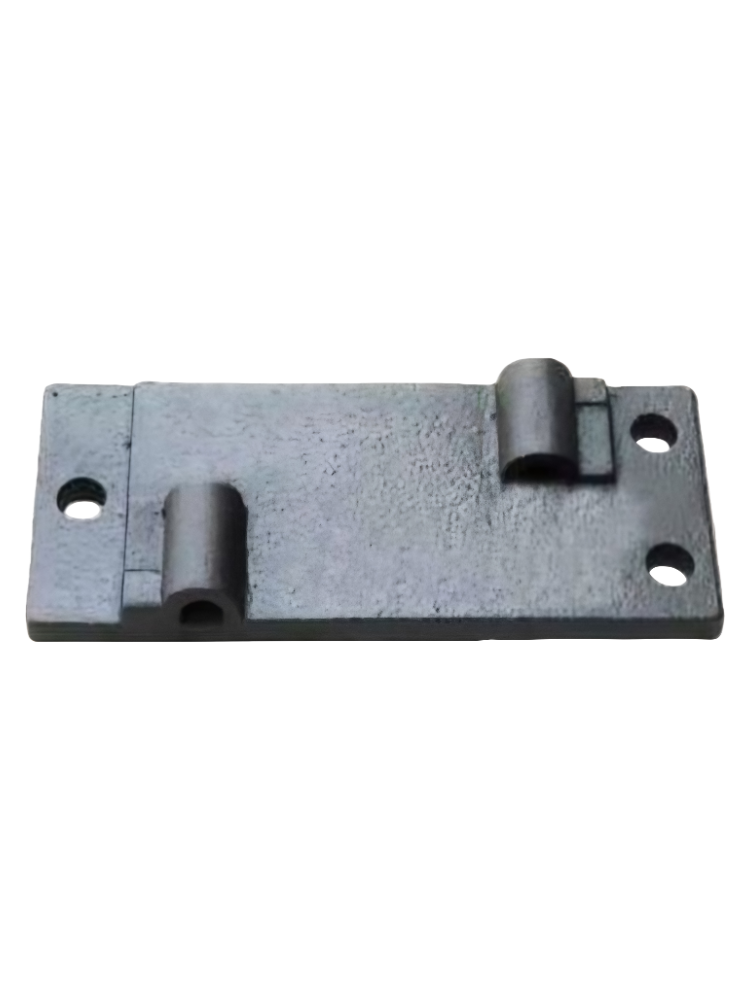
The edge geometry and any formed shoulders or ribs on the base plate must also conform to fastener seating requirements. A C-shaped wooden sleeper iron base plate, for example, has a specific profile designed to interface with rail foot dimensions and clip shoulders simultaneously. Altering either dimension independently without verifying the effect on the other contact points will compromise the entire assembly.
When specifying a replacement base plate, always record the original plate's thickness, web height, shoulder dimensions, and rib spacing from the existing assembly or from the original design drawing. These measurements are non-negotiable compatibility parameters.
Material and Surface Finish Compatibility
Matching Material Grades to Fastener Requirements
Material selection for a base plate must align with both the load environment and the corrosion protection approach used by the fastening system. Steel base plates paired with high-strength bolt assemblies must have compatible yield and tensile strength so that the clamping force developed by the fastener does not cause local yielding or deformation of the plate under the bolt head or washer.
A common compatibility error occurs when a standard-grade base plate is paired with high-tensile fasteners. The fastener can develop far greater clamping force than the plate material can sustain without deformation, leading to embedding of the washer into the plate surface, loss of preload, and eventual loosening of the joint. This is particularly relevant in high-vibration environments such as railway mainlines and industrial trackwork.
Always cross-reference the recommended material grade in the fastener system documentation against the base plate material certificate. For demanding applications, request tensile test certificates and chemical composition reports from the base plate manufacturer to confirm compliance.
Corrosion Protection and Surface Finish Alignment
Surface finish compatibility is a frequently overlooked aspect of base plate and fastener integration. Hot-dip galvanized base plates used alongside plain steel fasteners create galvanic couple conditions that can accelerate corrosion at the contact interface. Conversely, using untreated base plates in coastal or chemically aggressive environments when the fasteners are zinc-coated creates an unbalanced protective system.
For consistent corrosion protection, the surface treatment of the base plate should either match or be compatible with the fastener coating system. Hot-dip galvanizing, electro-galvanizing, mechanical galvanizing, or epoxy coating systems each have different thickness profiles, which in turn affect the dimensional fit of the assembled components. Always factor in the coating thickness when verifying dimensional compatibility.
Additionally, smooth or polished contact surfaces between a base plate and a rail pad or elastic clip seat can sometimes reduce friction grip, while overly rough surfaces may cause uneven load distribution. Surface roughness specifications should be part of the compatibility checklist shared between the base plate supplier and the fastener system designer.
Load and Performance Specification Alignment
Verifying Load Rating Compatibility
Each base plate is designed and tested for a specific load envelope, typically expressed as a maximum vertical load, lateral load, and longitudinal load in kilonewtons. The fastening components attached to it must be capable of developing clamping and restraint forces sufficient to keep the plate stable under these design loads. If the fasteners are rated for a lighter load regime than the base plate, they become the weak link in the system.
This issue is particularly relevant when upgrading a track to handle heavier axle loads. Engineers sometimes source a heavier-duty base plate without updating the fastening hardware, assuming the existing clips or bolts will suffice. In reality, the entire fastening system must be re-evaluated to ensure the new base plate can be held securely under increased dynamic forces.
Request load-deflection test data and fatigue test certificates for both the base plate and the fastening components. Compare the load ratings and service life expectations to confirm alignment. Where standards such as EN 13481 or AREMA specifications apply, ensure both components meet the same applicable standard.
Elastic and Thermal Movement Accommodation
A base plate and its fasteners must accommodate the same thermal expansion and contraction cycles without creating differential movement that loosens the joint or cracks the substrate. Steel base plates expand at a known rate; the fasteners must either be rigid enough to restrain this movement within acceptable limits or designed to allow controlled movement without compromising clamping force.
In applications where the base plate bridges a thermal joint or is used in climates with extreme temperature variation, confirm that the fastener system has been tested or specified for the expected thermal range. Some elastic clip systems are specifically designed to maintain consistent toe load across wide temperature ranges, making them better suited to base plates in exposed or arctic environments.
The combination of material selection, fastener stiffness, and pad elasticity all contribute to how well the base plate assembly manages thermal and dynamic movement. Consulting the fastener system designer early in the specification process avoids compatibility issues that only become apparent after installation in service conditions.
Procurement and Quality Verification Practices
Coordinating Between Base Plate and Fastener Suppliers
One of the most practical steps you can take to ensure base plate compatibility is to actively coordinate between the base plate supplier and the fastener system manufacturer before finalizing any order. This coordination should involve sharing full technical drawings, material specifications, and test reports from both parties so that potential mismatches can be identified before production begins.
Where a proven fastening system already exists on a project, request that the base plate supplier review and acknowledge compliance with the system's interface requirements in writing. This creates a documented chain of technical responsibility and reduces ambiguity at the installation stage. Products such as the base plate designed for C-shaped wooden sleeper applications are engineered to interface with standard fastening systems, but verification against project-specific fastener designs is always advisable.
Establishing a clear bill of materials that lists both the base plate specification and the fastener specification side by side helps procurement managers identify gaps before components reach the job site. This simple document discipline has prevented numerous costly compatibility failures in both rail and structural applications.
Incoming Inspection and First-Article Testing
Even when supplier documentation confirms compatibility on paper, physical incoming inspection is essential. Measure a representative sample of each base plate delivery against the critical dimensions identified during the compatibility check: hole diameter, hole spacing, plate thickness, shoulder height, and surface finish. Record and retain these measurements for traceability.
First-article testing, where a small number of base plates and fasteners are assembled and inspected before the full installation proceeds, is the most reliable way to confirm real-world compatibility. During the first-article assembly, check that bolts thread freely, clips seat correctly, toe load can be achieved, and there is no interference between components. Document the results and obtain sign-off from the responsible engineer.
Ongoing quality checks during installation should also include torque verification for bolted connections and clip gap measurement for elastic fastener systems. These in-process checks catch installation errors that could compromise the base plate assembly's long-term performance, even when the components themselves are fully compatible by specification.
FAQ
What documents should I collect to verify base plate compatibility with fasteners?
At a minimum, collect the dimensioned manufacturing drawing of the base plate, the fastener system technical data sheet, material certificates for both components, coating specifications, and the applicable design standard. For critical applications, also request load test certificates and first-article inspection reports. These documents together allow a full dimensional, material, and performance compatibility check before installation.
Can a base plate designed for one fastening system be used with a different system?
In most cases, it is not advisable to substitute a base plate from one fastening system into a different system without explicit technical review. The hole pattern, shoulder geometry, thickness, and material grade are all system-specific. However, if a thorough compatibility verification using dimensional drawings and material data confirms that all interface parameters match, substitution may be acceptable with the approval of the responsible engineer.
How does surface coating affect base plate and fastener assembly?
Surface coatings add measurable thickness to a base plate, which affects the fit of bolts, clips, and other fasteners. Hot-dip galvanizing, for example, can add 45 to 85 micrometers of coating thickness on each surface, which cumulatively alters hole diameter clearances and bearing surface positions. Always check that dimensional specifications account for the final coated dimensions, not just the base metal dimensions, to avoid assembly problems caused by coating interference.
What is the most common cause of base plate and fastener incompatibility on site?
The most common cause is sourcing the base plate and the fastening components from different suppliers without formal cross-verification of the interface dimensions and material grades. When each supplier produces to their own internal standard without referencing the other party's specification, small but critical differences in hole tolerances, shoulder heights, and material hardness can accumulate into significant assembly problems. Coordinated specification reviews and first-article testing before full-scale installation are the most effective preventive measures.
Table of Contents
- Understanding Base Plate Functions in Fastening Systems
- Dimensional Compatibility Checks
- Material and Surface Finish Compatibility
- Load and Performance Specification Alignment
- Procurement and Quality Verification Practices
-
FAQ
- What documents should I collect to verify base plate compatibility with fasteners?
- Can a base plate designed for one fastening system be used with a different system?
- How does surface coating affect base plate and fastener assembly?
- What is the most common cause of base plate and fastener incompatibility on site?